


I chose a good day, at the end of November, for my visit to La Estancia, in Sancti Petri, Cádiz. A good day because it was raining after months without rain, and this is something that is always good for the fields. The rain, I mean.
Anyway, it was not so intense that we could not play, comfortably even, because a little water is enough to deter those of us who are not so used to such inclement weather, and the truth is that there were very few kicking this new old field.
Opened in 2004 by the Meliá Group, under the name Golf Meliá Sancti Petri, it has been renamed La Estancia by the new ownership that took over last summer.
A new property, a new management and new and promising prospects. “We want to turn La Estancia into a reference course in Andalusia,” says its manager, Carlos de Avilés, “because it has great potential, based on a great design and an unbeatable location, without a single house interfering with play or aesthetics.”

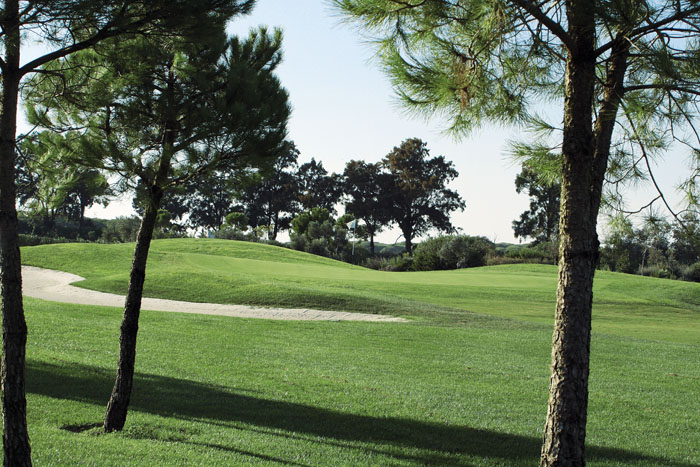
The course, totally flat, could be reminiscent of a links, despite not being by the sea, although it is influenced by the winds of the area.
The fairways, very wide, lead to large but lively greens. With four tees per hole, they allow, depending on the position, to play a long or relatively short course: 6,257 meters from white bars and 4,826 from red.
As it is a relatively recent field, the planted trees are not yet sufficiently grown, except for those that existed and were respected in the construction: olive trees, pines, etc.
“It’s a fun and different course,” notes Paco Cea, the club pro and director of the golf academy.
In his company -a luxury- and in that of Carlos de Avilés, a little self-conscious, because in my memory there was the memory of Paco playing the European Tour, rubbing shoulders with the golf elite of the Old Continent, I went out to play under a faint drizzle.
It was a priceless golf lesson, because Cea, besides being a good professional, is patient and has a great didactic vocation.
Hole 1, called El Muro, is, to begin with, a relatively short par 5, 459 meters from the yellows, and accessible. It has a slight dogleg to the left. The drive must be directed towards a bunker on the right, which is not easy to reach. From there, the second shot, to the green, if you want to try it, is straightforward and without any obstacle. The green is narrow but very long.
The 2nd is a par 4 of 346 meters. It is called La Casita because the old house of the caretaker of the estate was preserved. This small building is on the left side of the fairway. On the right there are two bunkers. The perfect tee line is a little to the right of the old farmhouse. From the tee you can see the whole hole, although there is also a dogleg to the right. The green is very wide and practically flat.
The next hole, hole 3, is much more complicated. It is a par 3 of 185 meters from which the town of Medina Sidonia can be seen. That is why it has been named after this beautiful town in Cádiz. The green is a little high, which also receives uphill and wind generally against. The par here is a magnificent result.
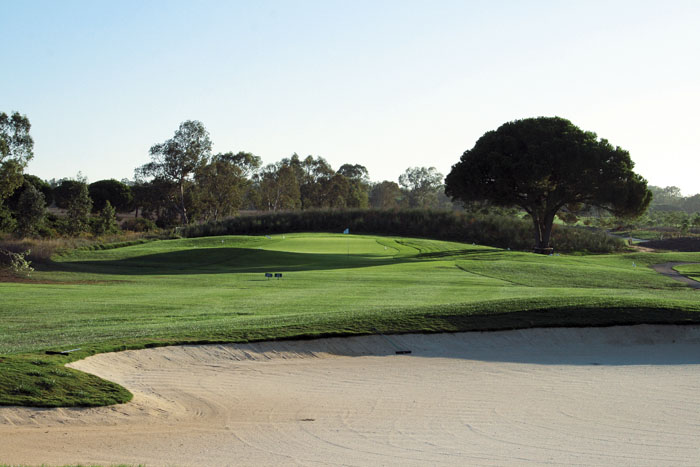
El Lago is the name of hole 4, a par 5 of 472 meters. With the drive you have to fly about 220 meters if you want to pass the water on the right side of the fairway. Otherwise, you have to lean a little to the left, where there are two bunkers that serve as a reference. In this case, it will be very difficult to reach a slightly elevated and very large green, the largest on the course.
Hole 5, called Campano, is a short par 4, 327 meters long, totally straight and flat. It poses no problems. There is a bunker on the left, at the drop of the drive, and pine trees on the right, but they do not have to come into play.
The next hole, 6, a 338-meter par 4, nicknamed El Pino, is a little more complicated. To the right there is a lake that cannot be seen from the tee, and to the left, a bunker. The second shot, from 100 or 120 meters, is very technical, because it has to be directed to a very small green, although without a great movement.
Hole 7, a 340-meter par 4, is called Cuesta Arriba, and lives up to its name. The fairway is split by a creek some 220 meters away, so it is better to tee off with a 3-wood and not risk flying over it. The green is high and has two pianos, and is also defended by a bunker on the left and water on the right. It is a complicated hole. Not in vain, it is the 3rd handicap of the course.
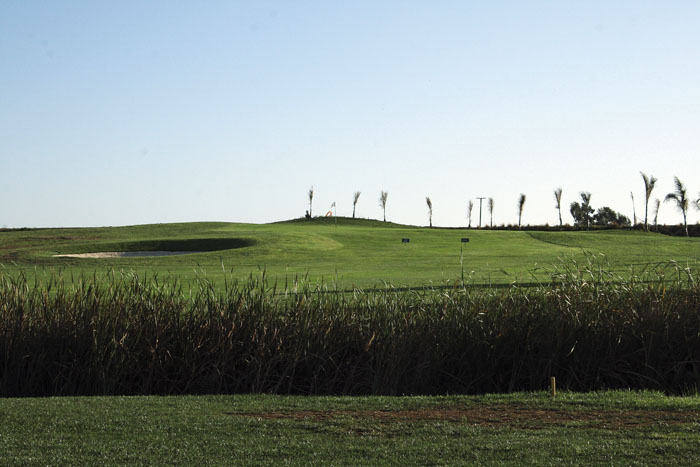
On the other hand, the next hole, the 8th, a 125-meter par 3 called La Sierra, is the easiest on the course: handicap 18. The tee is high and the green is wide with a slight drop to the left and protected by four bunkers.
Water is the name of hole 9, a par 4 of 306 meters and handicap 7. The tee-off is high and it is advisable to hit a hybrid or 3-wood at the most to stay before the lake. There is a second shot of about 120 meters to the green, located on an island. It is flat and receives well, but the water imposes.
After Agua, the 10th hole, a par 4 of 431 meters and handicap 2, could have no other name than El Pozo. It is a dogleg left. The tee-off offers no danger. To the right there are some pine trees and to the left a gravel area, but the fairway is wide. The green, flat, is high and with water on the left. It is not an easy hole at all, mainly because of the distance.
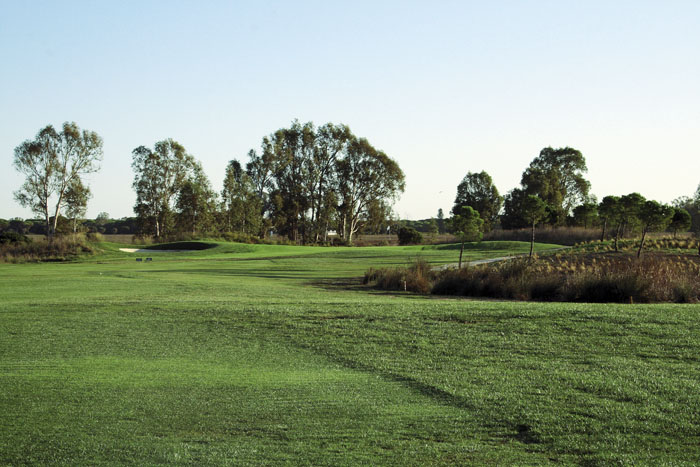
The 11th, called Colocar, is a 332-meter par 4 with a dogleg to the right of almost 90 degrees. The first shot must be hit very straight, taking care not to fall into the large bunker on the right located there so as not to shorten the hole. It is better to be on the left, about 200 meters away, which will give us a relatively short shot to a green with two platforms, very narrow, but very long.
The next hole, the 12th, called El Ciego, is a par 3 of 167 meters uphill, with small undulations in the fairway that do not allow a good view of the green, quite flat but with a drop to the right. A nice shot but you can’t see where the ball ends up.
The 13th is called La Serpiente and is a par 5 of 460 meters. True to its name, the fairway has a double dogleg, from the tee to the left and then to the right. For the first shot you have to lean a little to the left, over the olive trees that are there. The second stroke will be much straighter, to a wide fairway. The third, if we have placed it well before, does not have excessive problems to a green in the shape of a light bulb, narrow at the beginning and wide at the bottom.
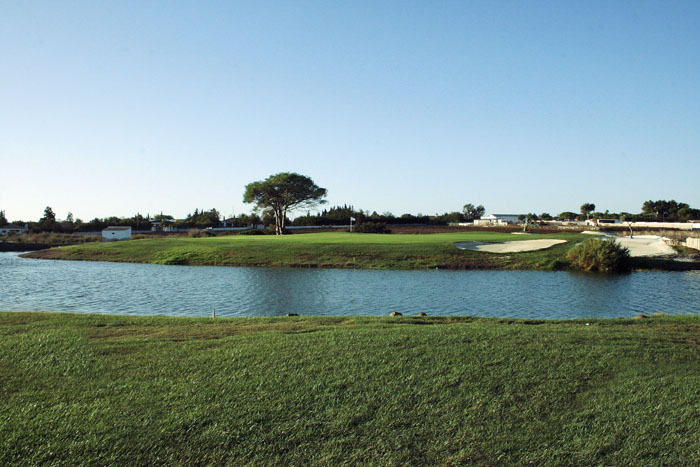
The Arroyo, a par 4 of 314 meters, is the next hole, the 14th. The fairway is crossed about 250 meters by a creek, which normally should not come into play. On the right there is rough and on the left is the next hole, so it is possible to lean on that area. The second shot will be to a green a little high and protected by a bunker on the left.
The 15th hole, Entre Pinos, is another par 4 of 372 meters. It is the course’s first handicap, which clearly reflects its difficulty. The tee-off is complicated because there is a large lake on the right side of the fairway, and three bunkers lurk on the left. The drive must be directed towards the center one and with precision, because the fairway is also split by a natural stream, about 50 meters from the green, which is a little high and with two very different slopes, to the right at the beginning and to the left further back. It is very wide, however.
Hole 16, El Salto, is a 164-meter par 3 with a high tee and a green protected by three bunkers, two on the left and one on the right. It is a complicated green because it is elevated in the middle, so it sends the ball sideways.
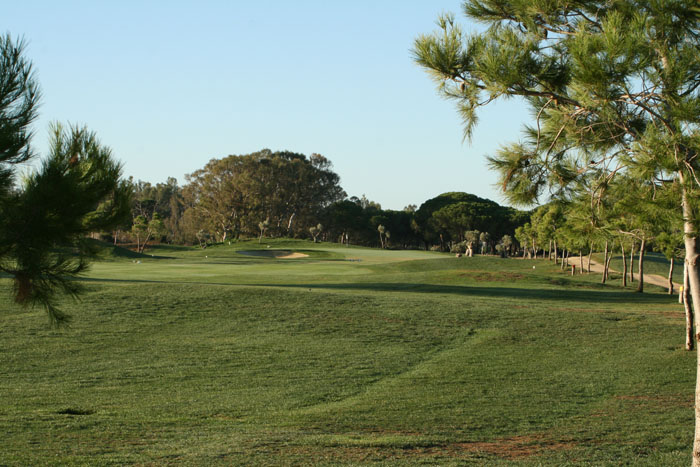
The 17th hole has been called Largo. It is a par 4 of 360 meters totally straight, with no complications at the tee. The tee is high, so you can see the whole fairway, which has trees, still small, on the left and right. The green is protected by a large bunker on the left. It is somewhat elevated and flan-shaped, with outward slopes.
To finish the course, the 18th, nicknamed Los Eucaliptos, a par 5 of 437 meters, is a hole quite influenced by the winds. The natural river that crosses the course in other areas splits the hole about 260 meters from the tee. Hitters and non-hitters have to play short to avoid reaching the large bunker located in the middle of the fairway before the stream. The second shot, by distance, can be to the green, but there is a eucalyptus tree in the river that bothers a lot. The green is protected by a bunker on the right and another, short, on the left. It is a little high and has two platforms. The second falls well to the right. The hole lends itself to a good result, but only if the second shot is very good.
A great pleasure
Playing with Paco and Carlos, as I have already mentioned, is a great pleasure and a luxury. Rarely do you have the opportunity to do it with someone who has played the European Tour.
Cea turned professional in 1995, played two years in the European Challenge Tour and from 1996 to 2001 he played in the first division of the Tour. His best season was in 1999, when he played in the Volvo Masters, finishing 56th in Europe. In 2001 he lost his card, but is still trying to get it back. “I can’t train like I used to, but I still have the bug for top competition,” he says.
His best results on the European Tour were the two times he finished third, in the Italian Open and the Madeira Open.
La Estancia’s transformation is going step by step, “meeting our expectations,” says its director, Carlos de Avilés.
“We have started by cleaning and tidying up the field and improving the entire irrigation network, which will allow us in the immediate future to reseed and change the variety of grass for the spring. We want to switch to bermuda,” he explains.
“The designer Alan Rijks has already been here to contribute ideas on the changes we want to make: new bunkers, tees, etc. We are going to lengthen the course by 300 meters, and our intention is to bring it to a high competition level in two years at the latest,” Carlos concludes.










Leave a Reply